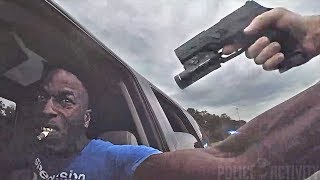
Newly released body-worn camera footage has ignited public debate after showing a law enforcement deputy clinging to a moving SUV moments before firing a fatal shot at the driver. The video, released by authorities as part of an ongoing investigation, offers a raw and unsettling look at a rapidly escalating encounter that unfolded in just seconds.
According to officials, the incident began as a routine law enforcement stop. Details surrounding the initial reason for the stop have not been fully disclosed, but investigators say the situation intensified when the driver of the SUV attempted to flee. The bodycam footage shows the deputy positioned near the driver’s side door as the vehicle suddenly accelerates. In the video, the deputy appears to be holding onto the SUV while being dragged forward.
As the vehicle continues to move, the footage captures the deputy shouting commands at the driver to stop. The camera shakes violently, reflecting the instability and danger of the moment. Within seconds, the deputy draws a firearm and fires at the driver. The SUV then slows and comes to a stop shortly afterward. Emergency medical personnel were called to the scene, but the driver was pronounced dead.
Authorities have emphasized that the video is only one piece of evidence in a broader investigation. Law enforcement leaders stated that the deputy feared for their life, citing the risk of being pulled under the vehicle or losing balance and suffering serious injury or death. From a use-of-force perspective, investigators will examine whether the deputy’s actions aligned with department policy and state law.
The release of the bodycam footage has sparked strong reactions from the public. Some viewers argue that the deputy was placed in immediate danger by the moving vehicle and had little choice in the moment. Others question whether different tactics could have been used earlier in the encounter to prevent the situation from escalating to lethal force.
Legal experts note that cases involving moving vehicles are among the most complex in use-of-force investigations. A vehicle can be considered a deadly weapon, particularly when an officer is trapped, dragged, or at risk of being crushed. At the same time, many police departments have updated their training to discourage officers from placing themselves in positions where they could be dragged by a vehicle.
Civil rights advocates are calling for transparency and accountability as the investigation continues. They stress the importance of releasing all available evidence, including additional camera angles, dispatch recordings, and witness statements, to provide a complete picture of what occurred.
For now, the deputy involved has been placed on administrative leave, a standard procedure in officer-involved shootings. Prosecutors will ultimately decide whether the use of deadly force was legally justified. As communities nationwide continue to scrutinize police encounters, this case underscores how quickly routine stops can turn into life-or-death situations—and how bodycam footage has become central to understanding and evaluating those moments.