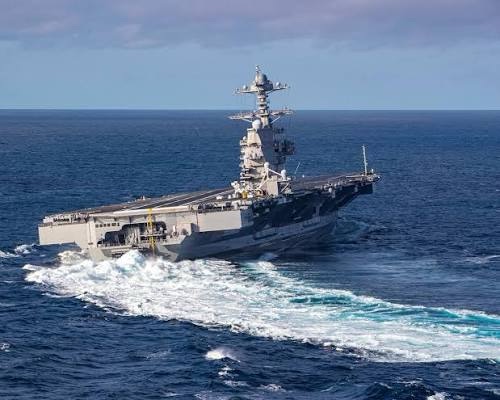
The USS Gerald R. Ford (CVN-78) stands today as the world’s most advanced aircraft carrier and one of the most complex machines ever built by humankind. As the lead ship of the U.S. Navy’s Ford-class carriers, she represents a massive leap in naval engineering, combat capability, and technological innovation. Named after the 38th President of the United States, Gerald Rudolph Ford, the ship not only honors his naval service during World War II but also signals the beginning of a new chapter in American sea power.
A Carrier Reimagined from the Keel Up
Construction of the USS Gerald R. Ford began in 2005 at Huntington Ingalls Industries’ Newport News Shipbuilding, the only shipyard in the United States capable of building nuclear-powered aircraft carriers. The ship was launched in 2013 and officially commissioned into the U.S. Navy on July 22, 2017.
Though she resembles the earlier Nimitz-class at a glance, the Ford-class design is entirely new. Nearly 70 percent of the systems on board are first-of-their-kind, including advanced electronics, catapult systems, radar arrays, reactor technology, and aircraft handling innovations. This makes CVN-78 the most digitally integrated and automated carrier ever produced.
At 1,106 feet in length and displacing over 100,000 tons, the Gerald R. Ford is a floating city with the capacity to house more than 4,500 sailors during full air-wing operations. Yet, thanks to technological upgrades and automation, the Ford-class requires 600–900 fewer crew members than the Nimitz-class, saving billions of dollars in long-term operating costs.
Next-Generation Power: The A1B Nuclear Reactor
The Ford-class is powered by two A1B nuclear reactors, each significantly more powerful than the A4W reactors used in the Nimitz-class. These reactors provide more than three times the electrical power, generating the necessary energy for advanced systems such as electromagnetic catapults, high-power sensors, and future laser weapons.
This extra electrical margin is one of the ship’s most important qualities. It ensures that the Ford remains capable not only today but decades from now as new forms of aircraft, defense systems, and shipboard technologies emerge. With a 50-year service life and no need for refueling until the mid-life overhaul, the vessel is engineered to serve far into the 21st century.
EMALS: The Future of Launching Aircraft
Perhaps the most talked-about innovation on the USS Gerald R. Ford is the Electromagnetic Aircraft Launch System (EMALS). Unlike traditional steam catapults that rely on high-pressure steam pistons, EMALS uses electromagnetic energy to accelerate aircraft smoothly along the flight deck.
Advantages of EMALS include:
Faster, smoother launches with less stress on the airframe Ability to launch lighter aircraft such as drones Higher sortie generation rate Faster recharging and lower maintenance
EMALS represents a turning point in naval aviation, allowing the Ford to operate efficiently with next-generation aircraft like the F-35C Lightning II, MQ-25 Stingray refueling drone, and future stealth drones.
Advanced Arresting Gear (AAG)
Complementing EMALS is the Advanced Arresting Gear, a new recovery system that replaces the hydraulic arresting gear used previously. AAG uses energy-absorbing turbines and digital control systems to safely stop aircraft.
This system offers:
Greater reliability Reduced stress on aircraft landing gear Ability to recover a wider range of aircraft sizes
The combination of EMALS and AAG gives the Gerald R. Ford unmatched flexibility and operational efficiency.
A Flight Deck Built for Speed
The Ford’s flight deck has been completely redesigned to support a 33% higher sortie generation rate than the Nimitz-class. Every second counts during combat operations, and the Ford’s layout minimizes choke points and optimizes the flow of aircraft from launch to recovery.

Innovations include:
A relocated island structure placed further aft and slightly outboard More deck space for aircraft movement Advanced weapons elevators that deliver munitions faster Intelligent deck-handling systems
These changes allow the ship’s air wing to launch and recover aircraft rapidly, maintaining pressure in high-intensity combat scenarios.
Weapons Elevators: Engineering Breakthroughs
One of the most technically challenging parts of the ship’s development was its 11 advanced weapons elevators. These elevators use electromagnetic motors instead of cables and hydraulics, enabling them to move ammunition more quickly and safely from the magazines to the flight deck.
Each elevator can lift 24,000 pounds at high speed, cutting down the time required to arm aircraft. Though they faced delays during early trials, all elevators are now fully operational and represent a major improvement in carrier readiness.
AN/SPY-6 Radar Suite and Sensor Dominance
The Ford-class incorporates the Dual Band Radar (DBR) system, which integrates two advanced radar arrays into a single multifunction set. It dramatically improves:
Air and missile detection Tracking range Targeting accuracy Resistance to electronic interference
The system is designed with future threats in mind, including hypersonic missiles and advanced stealth aircraft.
Life Aboard the Ship
Though still a war machine, the USS Gerald R. Ford improves the daily life of sailors. The ship includes:
Modernized living quarters Larger gyms Better dining facilities More reliable climate control Advanced digital systems for daily operations
Automation reduces the manpower burden, giving sailors more time to focus on specialized tasks.
Challenges and Triumphs
The Ford’s journey has not been without difficulties. Technical delays, tests, and cost overruns resulted in public criticism, but the ship has since proven itself in major trials, including:
Shock trials simulating battle conditions Advanced flight operations Deployments with NATO forces Integration with the F-35C
Each milestone has brought the carrier closer to full operational capability.
A Symbol of American Sea Power
In 2022–2024, USS Gerald R. Ford performed her first major deployment, operating in the Atlantic, Mediterranean, and participating in multinational exercises. Her presence signals deterrence, protection of global shipping routes, and readiness to respond to crises anywhere on Earth.
Conclusion
The USS Gerald R. Ford (CVN-78) is more than just a warship—it is a statement of technological ambition and national capability. As the first of a new generation of U.S. aircraft carriers, she pushes the boundaries of naval engineering with her nuclear power plant, electromagnetic systems, advanced radar, and optimized flight deck. After overcoming years of challenges, the Gerald R. Ford now stands fully ready to project American power, protect global stability, and serve as the backbone of carrier strike groups for the next half-century.