Modern warfare depends heavily on the effectiveness, reliability, and adaptability of infantry weapons. Among them, the assault rifle remains the backbone of every modern army, combining firepower, accuracy, and versatility in close- and mid-range combat. Over the decades, different nations have developed their own assault rifles tailored to their military doctrines, environments, and technological capabilities. This article explores five of the world’s top assault rifles currently in service: the M4 Carbine (USA), AK-12 (Russia), QBZ-191 (China), SA80 (United Kingdom), and G36 (Germany).
M4 Carbine (United States)

The M4 Carbine is one of the most widely recognized assault rifles in the world. Developed from the M16 platform, the M4 has been the standard infantry weapon of the U.S. military for decades and has seen extensive combat in Iraq, Afghanistan, and other global operations.
Chambered in 5.56×45mm NATO, the M4 is valued for its lightweight design, modularity, and accuracy. Its shorter barrel makes it ideal for urban warfare, vehicle operations, and close-quarters combat. The rifle features a flat-top Picatinny rail, allowing soldiers to mount optics, lasers, foregrips, suppressors, and other accessories.
While the M4 has faced criticism for reliability issues in extreme dust or sand conditions, continuous upgrades—such as improved bolt carriers, barrels, and ammunition—have kept it combat-effective. The M4’s adaptability and compatibility with NATO allies make it a dominant force on modern battlefields.
AK-12 (Russia)
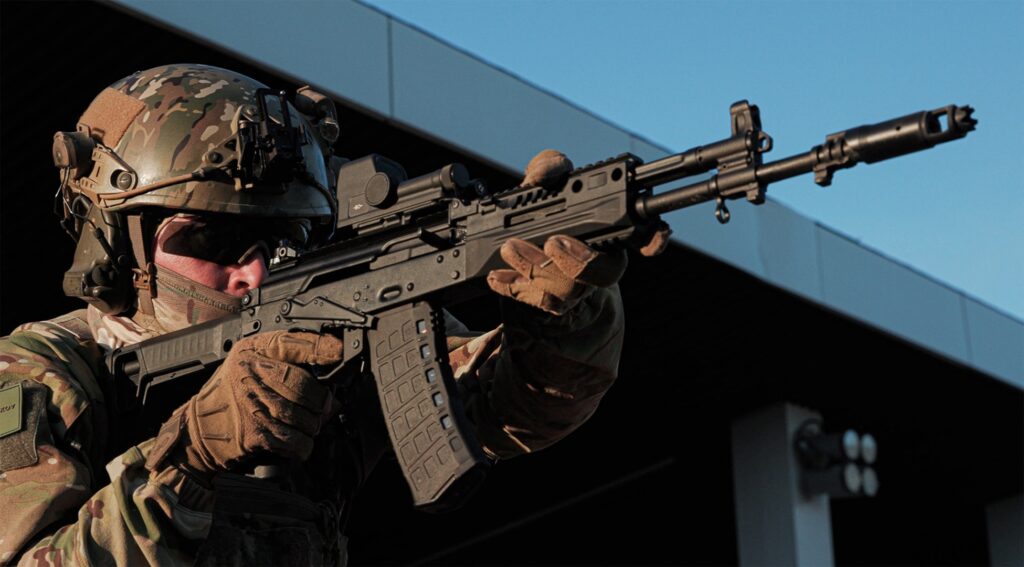
The AK-12 represents the latest evolution of the legendary Kalashnikov rifle family. Designed to replace older AK-74 variants, the AK-12 aims to modernize Russian infantry firepower while retaining the legendary durability the AK series is famous for.
Chambered in 5.45×39mm, the AK-12 features improved ergonomics, a redesigned muzzle brake, adjustable stock, and full Picatinny rails for optics and accessories. Unlike older AK models, the AK-12 is optimized for modern combat, emphasizing accuracy and modularity.
Despite early criticism regarding recoil control and burst-fire accuracy, refinements based on battlefield feedback have improved performance. The AK-12 maintains its reputation for functioning in mud, snow, sand, and harsh climates, making it especially suitable for Russia’s diverse terrain and extreme weather conditions.
QBZ-191 (China)

China’s QBZ-191 is a modern assault rifle developed to replace the older bullpup-style QBZ-95. The change reflects a shift in Chinese military doctrine toward modular, conventional rifle designs compatible with modern optics and accessories.
Chambered in 5.8×42mm, a proprietary Chinese cartridge, the QBZ-191 offers improved lethality, range, and penetration compared to older designs. The rifle features a free-floating barrel, improved ergonomics, ambidextrous controls, and integrated rail systems.
Designed with lessons learned from global conflicts, the QBZ-191 emphasizes accuracy, ease of maintenance, and adaptability. It performs well in diverse environments—from urban centers to mountainous terrain—demonstrating China’s growing emphasis on modern, professional infantry forces.
SA80 (United Kingdom)

The SA80, officially known as the L85, has one of the most controversial histories among modern assault rifles. Originally plagued by reliability issues after its introduction in the 1980s, the rifle underwent extensive redesigns, particularly with assistance from German manufacturer Heckler & Koch.
Chambered in 5.56×45mm NATO, the SA80 is a bullpup design, meaning the action and magazine are located behind the trigger. This allows for a longer barrel in a compact overall length, improving accuracy without sacrificing maneuverability.
After upgrades—most notably the L85A2 and L85A3 variants—the SA80 became a reliable and accurate weapon. British soldiers praise its precision, especially at longer ranges. While bullpup designs have ergonomic limitations, the SA80 now stands as a dependable infantry rifle after decades of refinement.
G36 (Germany)

The G36, developed by Heckler & Koch, became Germany’s standard service rifle in the late 1990s. Known for its lightweight polymer construction and futuristic appearance, the G36 was designed to be reliable, accurate, and easy to maintain.
Chambered in 5.56×45mm NATO, the G36 features an integrated optic system, folding stock, and excellent balance. Its design allows for quick target acquisition and comfortable handling, particularly for mechanized infantry units.
However, the G36 has faced controversy over reported accuracy loss during sustained fire at high temperatures. While debates continue regarding the severity of these issues, the rifle remains in service in several countries worldwide and has proven effective in many combat and peacekeeping missions.
Conclusion
Each of these assault rifles reflects the military philosophy and operational needs of its country. The M4 Carbine emphasizes modularity and coalition interoperability, the AK-12 focuses on durability and simplicity, the QBZ-191 represents China’s modernization drive, the SA80 demonstrates how persistent refinement can overcome early failures, and the G36 showcases lightweight innovation.
There is no single “best” assault rifle—only weapons best suited to specific doctrines, environments, and missions. Together, these rifles define the cutting edge of modern infantry combat and continue to shape the future of warfare.