The North American P-51 Mustang stands as one of the most iconic fighter aircraft in aviation history, celebrated for its unmatched range, speed, and agility during World War II. Yet behind its legendary reputation lies a fascinating story of rapid innovation, strategic necessity, and continuous engineering refinement. The evolution of the P-51 Mustang is not simply the story of a single aircraft—it is the narrative of how wartime urgency, brilliant engineering, and international collaboration transformed a promising prototype into a war-winning masterpiece.
Origins: A Fighter Born from Urgency
In 1940, Great Britain found itself in desperate need of high-performance fighters. The Royal Air Force approached North American Aviation, asking the company to build Curtiss P-40 Warhawks under license. Instead, North American proposed a completely new design—something faster, more advanced, and more capable than any fighter the RAF had at the time.
Within an astonishing 120 days, North American engineers rolled out the NA-73X prototype, the aircraft that would become the Mustang. Its design introduced innovations that set it apart from others of the era: a laminar-flow wing to reduce drag, a streamlined fuselage, and efficient radiator placement that actually generated a small amount of thrust.
The RAF accepted the aircraft as the Mustang Mk I, using it primarily for reconnaissance and ground attack. It was fast at low altitudes and well-armed, but one major limitation held it back—it struggled to perform at high altitudes due to its Allison V-1710 engine. This deficiency would become the turning point in the Mustang’s evolutionary story.

A Transformation: The Merlin Engine Revolution
The Mustang’s true evolution began when British engineers tested the aircraft with the Rolls-Royce Merlin engine. This engine, already powering the Spitfire and Hurricane, offered superb high-altitude performance. When combined with the Mustang’s advanced aerodynamics, the results were extraordinary.
North American incorporated the Packard-built Merlin into the design, creating the P-51B and P-51C variants. These aircraft could now climb higher, fly faster, and escort bombers deeper into enemy territory. Suddenly, the Mustang was no longer just a capable low-altitude fighter—it had become one of the finest escort fighters the world had ever seen.
The P-51B/C delivered a transformation that altered the air war over Europe. With their long range and improved performance, Mustangs were able to accompany American B-17 and B-24 bombers all the way to Germany and back. This drastically reduced bomber losses and crippled the Luftwaffe’s ability to challenge Allied air superiority.
Refinement and Perfection: The P-51D Arrives
The most famous and widely produced version of the Mustang emerged next—the P-51D. This variant represented the peak of Mustang evolution during the war. Engineers added a bubble canopy for improved visibility, six .50-caliber Browning machine guns, and improved fuel capacity. The P-51D offered:
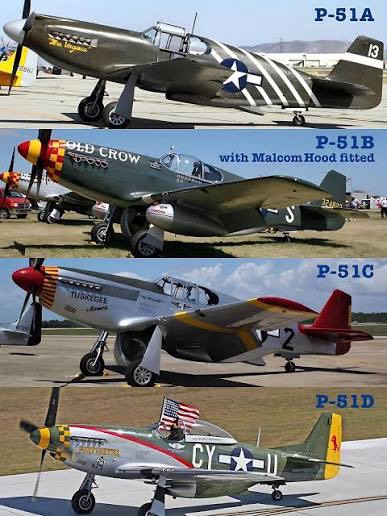
Outstanding maneuverability Exceptional range—up to 1,650 miles with drop tanks Superior high-altitude performance Stability and control at high speed
Pilots praised the P-51D for its smooth handling, especially in dive and climb transitions. It quickly earned a reputation for being a “pilot’s airplane”—responsive, forgiving, and lethal.
The P-51D became instrumental in securing Allied air dominance in 1944 and 1945. By escorting bombers deep into Nazi territory and aggressively engaging enemy fighters, Mustangs helped break the Luftwaffe’s defensive capability. Many of the most successful American aces—such as Bud Anderson and George Preddy—flew this legendary variant.
The P-51H and the Quest for More Speed
As the war approached its end, North American continued pushing the Mustang’s limits. The result was the P-51H, a lighter, faster, and more refined version built to fight in the Pacific. It featured:
A lighter airframe A more powerful Packard-Merlin V-1650-9 engine A top speed approaching 487 mph
The P-51H was among the fastest piston-engine fighters ever produced. Though it arrived too late to see combat in World War II, it reflected the peak of Mustang evolution. With improved climb rate, range, and agility, it represented everything engineers had learned from years of combat experience.
Postwar Evolution and New Missions
While jets quickly became the focus of postwar development, the Mustang continued evolving into new roles. It served in the Korean War as the F-51, providing close air support and ground attack capabilities. Its excellent range and ability to operate from rugged airstrips made it invaluable during the early months of the conflict.

Later, the Mustang found new life in foreign air forces, civil racing circuits, and private ownership. Modified Mustangs became dominant performers in air racing, especially in the National Championship Air Races in Reno, where highly tuned versions reached speeds far beyond wartime models.
Legacy of a Legend
The evolution of the P-51 Mustang reflects more than technological advancement—it shows how necessity, innovation, and global cooperation shaped one of the greatest fighters ever built. From its humble beginnings as a rush-developed prototype to its role as a long-range escort fighter and postwar multi-mission aircraft, the Mustang proved adaptable, resilient, and timeless.
The aircraft’s legacy endures today in museums, airshows, and private collections around the world. When a Mustang flies overhead, the distinct growl of its Merlin engine still captures the imagination of pilots, aviation enthusiasts, and historians. It represents the height of piston-engine fighter design and remains a symbol of both engineering brilliance and wartime courage.
The P-51 Mustang is not simply an aircraft—it is a testament to human ingenuity and a reminder of how the evolution of one machine can shape the course of history.